Skip Navigation Website Accessibility
Virtual and in-store private lessons
Ask about our famous lifetime guitar service plans
Over 1 million lessons taught
Serving Musicians since 1939
Since 1939  ·  1 Million+ Lessons Taught  ·  Colonie Center, Albany NY

Clarinet Lessons in Albany, NY

Looking for a clarinet teacher in Albany? Hilton School of Music has offered private clarinet lessons at Colonie Center since 1939 — 30-, 45-, and 60-minute sessions in person or online with a band educator who teaches all ages and all levels. Your goals set the agenda: crossing the register break, preparing a NYSSMA solo for All-State auditions, or just getting your first clear notes out of a single-reed instrument. You get a lesson plan built around exactly where you are, not a one-size-fits-all method book.

Call (518) 459-9400
Since 1939Over 1 Million Lessons Taught3 rd Generation Family BusinessColonie Center, Albany NY

Why Learn the Clarinet?

The clarinet is one of the most versatile instruments in the woodwind family — and one of the most requested in school band programs across the Capital Region. It sits at the heart of the concert band's woodwind section, carries lead lines in jazz and klezmer, and doubles as one of the most expressive solo voices in classical music. Benny Goodman made it the defining sound of the Swing era; Mozart wrote his Clarinet Concerto as one of the most beloved works in the orchestral canon. The clarinet earned that range by being both technically demanding and genuinely rewarding from the first lesson.

Here is the thing about the clarinet specifically: its single-reed design shares fundamental embouchure mechanics with the saxophone. A student who learns clarinet picks up saxophone with a head start on tone production — and vice versa. The clarinet's signature challenge is the register break, where the same hand moves into an entirely different part of the instrument's range. That transition is a milestone students talk about, and a good teacher makes it routine rather than mysterious.

Meet Your Clarinet Teacher

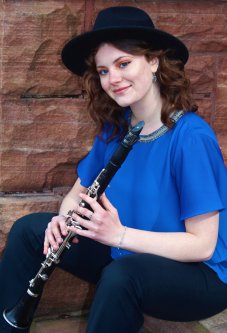
Ashton — Hilton Music Center instructor

Ashton

Band Educator — Ithaca College B.M. Music Education

Ashton leads Hilton's full band program, which means clarinet students get a teacher who has worked with every woodwind and brass instrument across every playing level. He studied music education at Ithaca College with an oboe concentration — giving him deep grounding in single-reed and double-reed technique that carries directly into clarinet instruction. Before joining Hilton, Ashton taught high-school band and chorus for grades 5 through 12. He knows what Capital Region band directors listen for in their sections, what NYSSMA adjudicators score, and how to move a student from first squeaks to a confident audition performance.

Clarinet is part of the full woodwind program Ashton runs at Colonie Center, alongside flute, saxophone, oboe, bassoon, and the brass instruments. He works with all ages and all starting points — from a child entering school band for the first time to an adult returning after years away. Lessons run in person at Colonie Center and online.

Specialties: Clarinet - Single-reed technique - NYSSMA solo preparation - Crossing the register break - Concert band prep - Beginner-friendly - All ages and levels - In person and online

What You'll Learn in Clarinet Lessons

1. Single-Reed Embouchure and First Tone

The clarinet uses a single reed pressed against a flat mouthpiece — the same basic principle as the saxophone. Ashton teaches the correct embouchure from the first session: lip cushion around the reed, chin flat, jaw angled to let the reed vibrate freely. Getting this right early prevents the biting habit that is the number-one cause of squeaking for beginners.

2. Reed Selection and Care

Not all reeds play the same. Beginners start on strength 2 or 2.5 reeds (Rico Royal and Vandoren are the school-band standards) — soft enough to respond easily but firm enough to produce a centered tone. You'll learn to seat a reed properly, wet it before playing, and identify when it is worn out. Reed management is the single most common source of inconsistent tone for beginners, and Ashton covers it from lesson one.

3. Boehm Fingering System

The modern clarinet uses the Boehm system — a standardized keywork layout now universal across school-band clarinets worldwide. You learn the full key layout methodically, building lower-register fluency before moving into the upper register. The logic is consistent and learnable; most students have the foundational fingerings down within the first few months.

4. Crossing the Register Break

The clarinet's defining technical milestone is crossing the break from the chalumeau (lower) register into the clarion (upper) register. Unlike the saxophone, which overblows to the octave, the clarinet overblows to the twelfth — so the same fingering with the register key produces a note considerably higher. Ashton drills the transition with specific exercises until the crossing feels smooth rather than alarming.

5. Articulation and Legato Playing

Concert band and classical clarinet favor a clean, connected legato — tip of tongue to tip of reed, notes flowing without harsh stops. Jazz and klezmer clarinet uses a warmer, looser articulation. Ashton teaches both styles and helps you understand which fits the music in front of you. Knowing when to tongue and when to slur separates players who sound musical from players who just hit the right pitches.

6. NYSSMA Preparation (Levels 1-6)

The New York State School Music Association solo festival is the primary performance benchmark for band students across North Colonie (Shaker), South Colonie, Guilderland, Niskayuna, Bethlehem, and Shenendehowa district programs. Ashton prepares students for Levels 1 through 6 — selecting appropriate literature, drilling required scales, and coaching the tone, intonation, and expression that adjudicators grade.

Why Choose Hilton for Clarinet Lessons in Albany

01

01 · A Dedicated Clarinet Program, Not a Buried Listing

Search other Albany-area competitors and clarinet appears under a generic "woodwinds" or "band" heading — no teacher named, no curriculum detail, no NYSSMA prep mentioned. Hilton treats clarinet as a distinct instrument with its own teacher, its own lesson structure, and its own program built around where you want to take it.

02

02 · Third-Generation Family Business Since 1939

Over one million lessons taught across more than 85 years in Albany. Hilton School of Music is a family institution with deep roots in the Capital Region — not a chain franchise or a side offering at a big-box store. When you choose Hilton, you work with people who have made music education their life's work for three generations.

03

03 · Clarinets on Our Retail Floor

Hilton is a full instrument retailer with band instruments on the floor. You can look at student-model clarinets before you decide, get Ashton's recommendation on which instrument fits your starting point, and walk upstairs to your lesson with the right horn already chosen. Buy any instrument for $200 or more and your first 30-minute lesson is free.

04

04 · NYSSMA and All-State Audition Prep

Clarinet is one of the most competitive instruments at NYSSMA solo festivals — and one of the most in-demand at All-State auditions. Ashton prepares students for Levels 1 through 6 with structured scale work, literature selection, and the performance details adjudicators score. For students in Capital Region school programs, this is direct preparation for what their band director requires.

05

05 · Colonie Center Convenience

Upstairs by Macy's at Colonie Center Mall on Wolf Road — right off the Northway (I-87) and I-90, with free mall parking and easy drop-off. Families from Latham, Loudonville, Guilderland, Niskayuna, Clifton Park, Schenectady, Troy, and Delmar come through here regularly. No searching for a tucked-away standalone studio.

06

06 · Student Recitals and Community

Hilton students perform in school recitals that give clarinet players a real performance goal to work toward. Playing in front of a small, supportive audience accelerates progress in ways that private practice alone never does.

Frequently Asked Questions

Why does my clarinet keep squeaking, and how do I fix it?

Clarinet squeaking almost always comes from one of three causes: an incomplete seal on a tone hole (finger placement off-center), a reed that is too stiff or too soft for the player, or a biting embouchure that pinches the reed shut. A teacher identifies the real cause in the first few minutes of a lesson — the fix is usually faster than students expect.

How do I cross the register break on clarinet, and why is it so hard?

The register break is the jump from the lower chalumeau register to the upper clarion register, and it trips up nearly every beginner for the same reason: it requires smooth, continuous airflow through the transition while adding the register key and new fingerings simultaneously. The technique that makes it click is air — not speed, not force. Most students cross the break cleanly within two to three months of consistent weekly lessons and daily practice.

What reed strength should a beginner clarinet player start on?

Strength 2 or 2.5 is the standard starting point for beginners. A reed that is too stiff causes jaw fatigue and squeaking; one that is too soft makes the tone airy and impossible to control. Ashton guides students on reed selection from the first lesson — and covers how to tell when a reed is worn out and needs replacing.

Should my child start on a plastic clarinet or a wooden one?

Student-grade ABS plastic clarinets from Yamaha or Jupiter are the correct choice for beginners. Plastic resists humidity cracking, requires less maintenance than grenadilla wood, and plays just as well for the first several years of study. Wooden clarinets are for advanced and collegiate players. Hilton has band instruments on the floor; Ashton can point you to the right student model before the first lesson.

What is the difference between a Bb clarinet and an A clarinet, and which does my child need?

Beginners always start on the Bb soprano clarinet — it is the instrument in every school band program in New York State. The A clarinet is used in orchestra for pieces written in sharp keys; most students do not encounter it until advanced or collegiate study. For NYSSMA prep and school band through high school, the Bb clarinet is all your child needs.

Is clarinet harder to learn than saxophone?

The two instruments share a single-reed embouchure, so the basic tone-production concept is similar. Clarinet is often considered harder to begin because the open tone holes require a complete, centered seal from every finger — no partial coverage the way saxophone pads allow — and the register break demands precise technique before the full range opens up. Most saxophone players who try clarinet say the first month is the hardest part, then it clicks.

How do you play different notes if you are already covering all the tone holes?

Pressing the register key on the back of the clarinet causes the same fingering to produce a note a twelfth higher rather than an octave higher (as on saxophone). This is why clarinet has two distinct registers that feel almost like separate instruments at first. The register key is what unlocks the upper range — and Ashton introduces this concept methodically so students build the muscle memory for both registers before the transition feels abrupt.

How much do clarinet lessons cost at Hilton?

Clarinet lessons are priced by session length in 4-week packs: $150 for 30-minute lessons, $225 for 45-minute lessons, and $300 for 60-minute lessons. A single 30-minute lesson is $40. Purchase any instrument from Hilton for $200 or more and your first half-hour lesson is free.

Lesson Pricing

4-Week Pack — 30 min $150
4-Week Pack — 45 min $225
4-Week Pack — 60 min $300
Single Lesson — 30 min $40
Free half-hour lesson FREE With any instrument purchase of $200 or more

Ready to Start?

A dedicated clarinet program with NYSSMA prep included, no extra charge, all ages welcome. First time picking up a clarinet, returning after years away from the instrument, or preparing for a district All-State audition — Ashton builds a lesson plan around exactly where you are. Stop by Colonie Center or call us to get started.

Call (518) 459-9400
Lessons Inquiry

Fill out the form or call in to sign up! (518) 459-9400
About Our Home

Music in Albany — New York's Capital Region

Hilton Music Center has called Albany, New York, home since 1939. Our studios sit upstairs at Colonie Center on the corner of Wolf Road and Central Avenue — just a short drive from Lark Street's arts and dining strip, the historic Center Square neighborhood, and the cultural anchors of Empire State Plaza.

New York's capital is also one of the country's most underrated music cities. Washington Park hosts the Park Playhouse and outdoor concerts every summer. The MVP Arena (formerly Times Union Center) brings touring acts downtown. The Egg at Empire State Plaza books world-class chamber, jazz, and contemporary performers. Lark Street's bars and clubs host singer-songwriters, jam bands, and local rock acts year-round, and the annual Albany Tulip Festival brings free concerts to Washington Park every May.

Beyond Albany proper, the Capital Region — including Colonie, Latham, Loudonville, Delmar, Guilderland, Bethlehem, Niskayuna, Clifton Park, Troy, Schenectady, and Saratoga Springs — is dense with school music programs, community orchestras, church music ministries, and working musicians. Hilton students perform at NYSSMA evaluations across upstate New York, in school orchestras and bands from Bethlehem Central to Shenendehowa, and on stages from Caffè Lena in Saratoga to The Egg in Albany. We're proud to be part of that musical fabric — and we'd love to be part of yours.

Driving Directions

How to Find Hilton Music Center — 440 Colonie Center, Albany, NY 12205

Hilton Music Center is upstairs at Colonie Center Mall, by Macy's. Free covered mall parking, all-weather access, and easy reach from anywhere in the Capital Region. We're at the intersection of Wolf Road and Central Avenue (NY-5) — the busiest commercial corridor in upstate New York. Open Monday through Saturday 10:30am–8pm, Sunday 11am–6pm.

Address: 440 Colonie Center, Albany, NY 12205
Phone: (518) 459-9400

Click any of the destinations below for turn-by-turn driving directions to our studio — or use the live Google map to the right to plan your route in advance.

From Albany Neighborhoods

From Capital Region Towns & Villages

From Surrounding Capital Region Cities

From Capital Region Landmarks & Points of Interest

Find Us!
Guarantee Premium Quality Guaranteed Safe Checkout
Accepted Payment: Mastercard, Visa, Discover, American Express
Contact Info